Tuesday, January 24, 2017

League of Legends

League of Legends is one of the most played games in the United States today.  And luckily for us, we got to binge it for three days straight!  Over this three day period, we experienced a wide range of emotions and opinions about the game.  Even though we all played the same game, we had different experiences and reactions to it.  Ultimately, we concluded that it really isn’t worth all the hype.  Here is why.


Reva…
league-of-legends-map.jpgThe main problem I had with the game was the sheer repetitiveness of it.  I wasn’t big into video games as a kid, but going into this binge I had the idea that I would be entering this fantasy world with a serious mission -- but I was very mistaken.  I am sure there are games like that out there, but League of Legends is not one of them.  After I played a couple of games, I realized that there wasn’t much else to the game.  It consisted of fighting the same enemies in the same landscape for basically eternity.  I guess the goal was to get better and better, but I became extremely unmotivated when I found out that there was no greater purpose.  I mean, at least in Super Mario Bros you work towards saving Princess Peach.  All I can say about this experience is that I immediately deleted League of Legends off my computer when the binge was over.  I don’t think I will be returning…  

Margaret…
Before this binge, the only real video game experience I had was with Nintendogs, a game where to you take care of puppies and play with them. League of Legends is very different from my favorite fourth grade game, so it was difficult to get used to such an interactive and complicated game. I struggled to learn how to control each character, work with my online teammates, and figure out how to kill the other opponents in each match. After three days, I had become fairly good at the game, but nowhere close to a pro. Even though I kept playing the same game and participating in identical matches, I was only a level 5 and I still died a lot. Looking back on this binge, I don’t think I will play League of Legends again anytime soon. Although I liked winning the battles and learning the game with my friends, I never made any real progress; LoL is only so much fun for a short period of time.

Hadis...
League of Legend is a strategic video game.  In this game you are about 40% dependent on your teammates in terms of whether they get to help you win or leave you to die on your own. The computer graphic design is ridiculously appealing. Because it is very detailed, the whole game experience is very exciting and mysterious; in every corner or on every wall there is always something more than what our eyes can see at first glance.  One of the main reasons this game is so attractive is its incredible graphics.  


Addie…
trundle.jpgUpon entering this binge, I was actually excited to play League of Legends since I figured the eighteen hours would move faster if I was controlling and interacting with something. However, my three days got off to a pretty rough start with lots of technical difficulties and sheer lack of video game knowledge (read: The only video game I play is Just Dance). Even after I sort of understood the basics of League of Legends, my character was still dying approximately twenty times each game. This went on consistently for the first two days of the binge. I would kill two, maybe three people in a game if I was lucky, and I would be killed every other minute. On day three though, something wild happened. I was killing six or eight people in a game and only dying three or four times. As I type these words, I realize that any average League of Legends player would laugh in my face for how awful those stats are, but I felt like a goddamn Legend. I’m not sure if I’ll end up returning to the game since it is pretty episodic and repetitive, but who knows? Plus, I do have beef with a character named Trundle who killed me sixteen times in one game, so I am still on the prowl for Trundle vengeance.

Monday, January 23, 2017

The seemingly harsh, but equilly nastaglic review of our games, and the final goodbye to the 2017 Binge

By:Nolan, Emma, Ronald and Wesley


I think it is easy to say that this third and final binge was this group's most enjoyable of the three different binges. I think I can speak for most of us when I say that our group simply plays more video games than most people, so this one felt the most natural and much less like work. I myself can easily say that when I got up every morning to binge, I actually was really looking forward to spending the next several hours playing the same game.
All four of us agreed that we loved bingeing in a group more than by ourselves. We felt that by playing around other people playing the same game, there was a sense of comradery and similar interest of goals within the game and within the atmosphere of the room. We had fun, we laughed and even here and there we had some slight competition between us to see who could get through the game faster. Or when one of us would be behind, we found ourselves peeping at the other person's screen to see what happens further in the game. It just felt low key, relaxing and overall like fun.
However, no game can go without its criticisms. As fun as both games that we played were, there were some aspects that made us enjoy it just that much less. For example, we all agreed that the story for Murdered:Soul Suspect the story could have been added too a little. For the most part we agreed that the story felt perhaps a little lacking, or there were things that could have been easily implemented to game the play time longer, the story less predictable or to add more variety. One thing we all agreed on heavily was that the camera angles in Thief  were very nauseating and uncomfortable to play with. Emma and Ronald both had a difficult time dealing with the fast motions of the first person camera (when you see from the eyes of the player character). Some gameplay segments felt pushed in and unnecessary, or there would be a mission segment where the difficulty seemed to be raised for unnecessary reason, making progressing more of a chore than fun.
There might have been a handful of critics, but overall we all enjoyed playing these games. This class and the binge experiment itself has been quite the experience to say the least. We all had an enjoyable time going through it and testing our will against hours and hours of non stop consumption of media. But, we prevailed nonetheless, which looking at my group mates, that was to be expected!

Playing God, or More Commonly Known as Sims 3

Kicking off our last binge, our group (Jenny, Kinye, Mallary, Christina, and Nate) played roughly 18 hours of The Sims 3. The Sims series puts the player in charge of the game-making, so the ludology is entirely up to them. These are our testimonies (dun dun).


One day after work, Honey B decides to visit her significant other. Honey B’s feelings have been growing more for this kind and thoughtful gentleman. Upon arrival, Honey B is unaware that Marcell (her significant other) lives with a roommate. She warmly greets Marcell’s roommate, Elizabeth. After some chatter, Honey B becomes aware of her hunger levels, which had decreased during work. She shares a dinner with Marcell. Meanwhile, Elizabeth occupies the kitchen space along side of the happy couple. After dinner, Marcell and Honey B decide to become intimately and romantically engaged, only leading up to Elizabeth (Marcell’s wife) to kicking ignorant Honey B out. Who here is to blame?


The main objective and goals derived from your sim’s personality traits are the only aspects contributing to your stories narratology. In The Sims 3, the player creates the space and characters they want to be in control of, like a god. Certain events can occur, causing a challenge for the player. One of our group members decided to let all hell break loose the last day of the binge to see who would survive. Similar to the popular book series The Hunger Games, the goal is to stay alive and play your part. Obstacles will be thrown in your way such as death or losing your job, but for the most part it’s randomly generated to keep the player engaged and feeling like they are in control of the plot and narratology.


Sitting for 6 hours a day was most definitely much more enthusiastic when we had the group dynamic at play. We each shared insight on what was happenin’ in our fantasy worlds. We laughed at outrageous aspects of the game, and sympathized when a baby was born or a couple broke up, much like Honey B and Marcell.

Unless you know the cheats for money, and happiness, you will constantly stress about the finances and other levels needing attention. It tends to become very tedious. There were times when one character needs to shower, one is late for work, the other school, and the other is super sick. Juggling all these aspects into a fantasy world added to the entertainment and pleasure of this game, helping point it to the fun side of the spectrum. Many of our group members happened to play over the time needed for the binge, but who can really stop when you’re playing god?

Lord of the Binge

A Darkness grows in the east, as Sauron, chief lieutenant of the dark lord Morgoth, grows in power. It is up to you, stalwart traveler, to join the fray, form a fellowship and save middle earth! For the last binge, we chose to binge Lord of the Rings Online (or LOTRO). We had a fairly large group consisting of Will, John, Rebecca, Collin, Katie, and Jonah. As a Massively Multiplayer Online Role Playing Game (or MMORPG,) LOTRO allows it’s players to choose from a variety of races (Human, Hobbit, Dwarf, Elf, and Beorning) and classes (Burglar, Captain, Champion, Guardian, Hunter, lore-Master, minstrel, rune-keeper, and warden). The different mixtures of these end up changing the stats and abilities of your character, allowing for a number of different playing styles. The character creation alone can take quite some time, which is why we decided before going into the game that we wanted to choose our classes and races. This also served to optimize our team. We found that we enjoyed playing the game together, when we could ask each other questions, play together in game, or just point out funny/ interesting things that we would notice in the game.
To a more experienced MMORPG player this game will feel slightly cookie cutter, and a lot like World of Warcraft. Some of us noticed that, though Tolkien had inspired a lot of what is now standard for the fantasy genre, at times it felt just like playing any other fantasy MMORPG. This was not helped by the execution of the game’s narrative. One thing that is fairly unique to LOTRO is the amount of customization of player avatar.
The narrative in the game relies heavily on the preexisting narrative of the books and movies. When doing a main quest there would occasionally be a cut-scene to give context, but other than that the only way to get the most out of the narrative is to read the text in the quest’s description. The majority of the quests were not for the main plotline.  This meant that we had some trouble getting attached to the main plotline, as it was difficult to know which quests were side quests.
One of the most enticing components of the game is the freedom of the open world. The player is given a map of the world, which can zoom in as close as cities and zoom out far enough to see all of middle earth. The amazing thing is that no areas are technically off limits; if a player wanted to jump in and go straight to Rivendell (a famous location from the Lord of the Rings books and movies), they would be free to try, but their journey there would be treacherous and most likely impossible. This restricted us to a select few locations in the game, which we were the proper level to play. This, though slightly frustrating, was ultimately not terrible, because these areas themselves were fairly large and ranged widely from dwarven strongholds to elven cities. One beginning level area is the shire. This is where the protagonists Frodo and Bilbo Baggins are from. A quaint location, inspired by the villages of the English countrysides, we would get to know the intricacies of the simple lifestyle of the hobbits. A lot of us found that these quests, though at times comedic, felt trivial in their context of a combat heavy game.
The sheer number of things that the player can do in the game can be slightly intimidating. There are skill trees for each character, in addition there are abilities unique to certain classes and races, as well as a complex crafting system, hobbies, player vs. player, and that is only naming a few. This results in a user design of the game that can be difficult to understand or remember. One thing that a few of us noticed was the redundancies of certain game mechanics. For example, if you and your friends wanted to play online together, you can add them as your friend’s list, or you could join a fellowship with them, or a kinship, very similar. In addition the store had some overly complicated aspects. There were LOTRO points, which you could get by both playing the game, or buy, and there was also mithril coins which were also bought outside of the game to purchase items in the game. Some quests would give you coins or points, but then some quests had to be bought with coins or points. Because this is such an old game (originally released about a decade ago) it has had many updates and re-releases. We think that this may be the cause for some of these redundancies.
Overall, we enjoyed playing; it was nice to escape into a fantasy world for a spell. MMORPG’s are notorious for binging, so it was not hard for us to play in terms of stickiness; the first group session we actually played for an extra hour without realizing! That in mind, by the end of the third day of binging it was not hard for us to find some of the mechanics in the game that could use improvement. But for a free game that’s almost ten years old it holds up remarkably well.

Wednesday, January 18, 2017

The D.U.N.E. Series: Depressing Unending Novel that Elicits interest

The first few pages (maybe 100-150) were a bit of a struggle as we (Katie, Will, and Collin) tried to get familiar with the world of Dune and the vocabulary that Herbert invented for the novel. It’s a bit of a coming-of-age story, but highly political and on a far-off desert planet called Arrakis, with hyper-cognitive abilities and spice… and sandworms… and other cool things like birds that drink blood as a source of water. It’s a very thoroughly thought-out world that just takes a little bit of time to get into. Finding the glossary in the back before reading for six hours would help....

In Dune, a young boy named Paul has been trained by his mother, a Bene Gesserit, to have heightened senses which come in handy for telling if people are lying or nervous, among other things. He is thought to be the Kwisatz Haderach (a male Bene Gesserit who can bridge space and time with his mental powers). Their family arrives on Arrakis as royalty, taking control of spice mines (the most valuable resource in the universe, apparently), and deal with the politics and threats that follow. There is an invented religion and a whole manner of thinking that the natives of the planet hold which is based around water, a highly limited resource to the point that they wear stillsuits which recycle their body’s moisture, losing only a thimble’s worth per day. (Dew Gatherer is a profession on Arrakis. They gather dew.) There are assassination plots, cultural clashes, class issues, mindgames, action scenes, GIANT SANDWORMS, and basically no hope at all ever.
fzd_duneDC69_highres_01.jpg

One of the things that we found interesting about our text is how the author was able to include the thoughts of characters within the text. These thoughts helped give the reader another perspective from a certain character's point of view and also sometimes served as foreshadowing in the story. One of the times that these thoughts are used as foreshadowing reference to ancient text that would point to the main character (Paul) being the chosen one! The thoughts were also not limited to a couple characters but showed most characters perspectives and helped the reader get to know that character better.

The most enjoyable aspect of this binge for our group was when the three of us were binge reading together.  We found ourselves more easily focused and able to stay on task with the book while also discussing new and exciting plot points as we progressed.  When we binged on our own the time seemed to still go by more quickly than it did during the television binge however it did tend to drag on just a bit more.  Having your group members around you forced us to keep our minds on task while suppressing the desire to busy our minds with something other than the daunting task of an 800-page novel.  Another perk of being in the group setting was being able to talk out confusing parts of the book where the author took his liberty with language and created words of his own.  If it weren’t for the group as a whole some of us may not have even found the very handy glossary in the appendix.  It was clear that we enjoyed the group binge of this book far and beyond the solo binge.
Foundation: Predicting The Future With Math, History, and Psychology


    For the 2017 Jan-term our group (Mallary, Nolan, Hadis, and John) binge read the books Foundation and Foundation and Empire, the first and second novels of the Foundation Trilogy by Isaac Asimov. Asimov divided his books into parts that were separated by several decades, sometimes even a century. For instance, Foundation, Part III, is about a war between the societies of Terminus and Anacreon, two different planets with light-years in between them. But in part IV of the book this war had become simply a fragment of history, with the new part taking place five decades later. Our group found the series to be slower when compared to the television binge, what with how much space Asimov devotes to setting up back-story and to build both tension and plot. He takes time to set up the main premise of his novels’ various plots: that through the usage of highly developed probability math, a deep understanding of human history, and a good lot of psychological knowledge, humanity might be able to one day successfully predict how our future will turn out (given the right variables are accounted for).

    By the time we reached the second novel, the course of the story had spanned over TWO. HUNDRED. YEARS. (Let that sink in).

    Asimov, showing us that he is aware of how humanity has changed over time in real-life, has the dialects and dialogues of his titular society, the Foundation, morph. They are different at the beginning of his trilogy than they are by the middle of the trilogy’s second book. For instance, during the first part, words of formality, such as lord, sire, and majesty, are frequently used when addressing authority. However, during the second book, a subsect of the Foundation society has begun using dialogue that is less formal, with words such as ‘boss’ and ‘doc’ addressing authority. The language becomes anachronistic, as it closely resembles common speech of the 1950s (think Bugs Bunny’s “What’s up, doc?”), despite taking place centuries in the future.

    On the whole we enjoyed what of the Foundation Trilogy that we read, with it’s politics, action, and sharp-witted characters. For lovers of sci-fi or House of Cards alike, we suggest this story to you.

images.jpeg

Phase two of the binge, and our own hitchhike through this one of a kind sci-fi story
By: Addie, Ronald, Wesley, Jonah


Three days. Four Earth-men. One journey to read as much of The Hitchhiker’s Guide to the Galaxy series as possible. While on this quest of binge-reading, we discovered that some things just aren’t meant to be consumed at this rate. A human can only take so much of Douglas Adams’ humor in one sitting. His dry, omniscient, and ironic comedy makes it simple to dive right into his nonsensical intergalactic journey. Especially for people who may not be super into sci-fi novels, the little giggles help ease your way into that world. That being said, around page two-hundred-and-something-something of the same thing, you just want Adams to be quiet and develop the plot a little more.
There were decent chunks of the series where I glossed over every word, because I knew exactly what was coming next. The Hitchhiker’s Guide to the Galaxy started with a bang, and ended with many whimpers. After the first major plot point of Earth exploding, Adams created a pattern that went as follows: One insignificant, but kind of dangerous thing would happen. All the characters would talk about how they were going to die. Adams would make some remark, insinuating that they were all dumb for thinking they would actually die. The insignificant, dangerous thing would resolve itself, and they all live happily ever after. Yes, the shenanigans were silly and funny and gave us some solid chuckles, but we started to crave some actual narrative arc.
We completed this binge after our three-day TV binge, and this was a whole new world of media consumption. Binge-watching TV is mindless and moves quickly and allows you to get a more holistic view of the story because of its visuals. But binge-reading makes you work harder to understand the plot and characters. You have to paint an image of the characters in your head, and play out scenes without being able to see them happen. As a result, binge-reading can make you feel more creative and inspired because it forces you to envision the plot as it moves quickly by you. In The Hitchhiker’s Guide to the Galaxy series, the author doesn’t spend much time describing the scenery or the appearance of the characters, so it can be tough, but it makes the binge-reader have to work that much more.
The Hitchhiker’s Guide to the Galaxy is a fun and easy series, but binge-reading it may not be the way to go. The short blips of excitement, supplemented with Adams’ humor is fun for a while. However, I would at least take some time to breathe in between books, if you’re going to tackle this strange series.

Beyond the Highland Mist: A Fun, Cheesy Binge

By Emma, Kinye, Kristina and Jenny

Looking for your next cheesy, beachside binge? Eager to enter a world of scandalous soldiers and daring demoiselles? Yearning for a good book to curl up with on those long winter nights and rainy spring afternoons? Well, look no further: Karen Moning's Highlander series has got you covered. Set in Renaissance Scotland, the first book in the series, Beyond The Highland Mist, covers the tale of one Adrienne de Simone and her (forced) journey through time to an era averse to her fiery, feminist sensibilities. Equal parts cunning, college-educated and charmingly clever, Adrienne, nevertheless, finds herself used as a pawn in a supernatural chess match between the fairy king and the man who was foolish enough to (unknowingly) anger said king: Scottish nobleman and (de facto) political hostage to the king of Scotland (as one can see, he has a gift for raising the ire of kings), Sid-hawk James Lyon Douglas. 

Hawk, as he is referred to by pretty much everyone who can't be bothered with the aristocratic pretension of his first name, is the quintessential Highland warrior: daring, brash, brave, charming, clever, seductive...blah, blah, blah. To make what could be a very long critique pleasantly short: Hawk is pretty much perfect--except for his unfailing arrogance when it comes to charming people, that is. And that's probably why he and Adrienne work so well together: beyond just a game of cat-and-mouse, their love is a (HISTORICALLY INACCURATE) journey of self-discovery, set against a lush, lurid interplay between a magic that neither can even begin to comprehend and the kind of violence that threatens to consume them whole. For all the myth-savvy readers out there, Hawk and Adrienne are basically a Scottish Helen and Paris. Or, if you prefer an even more tragic comparison between misbegotten lovers, a Scottish version of Abelard and Heloise. They are the kind of couple worth going over a cliff for. The kind of couple you hope will make it, but just know that they're doomed. The kind you cry over, even knowing from the very start that a love so sweet, so pure can never last in a world so cruel. Or, at least from a cynic's point of view, that's how they're marketed--and judging by the book's sales, it's safe to say that such image manipulation really did pay off.

Overall, it's a decent book. It's not stunning. It's not revolutionary. It's not going to broaden your intellectual horizons (maybe it could have, had there not been so many glaring historical inaccuracies) or inspire you to paint an immortal masterpiece. It'd be easy to compare it to Twilight, but that seems unfair to Karen Moning, since she actually put effort into the book she wrote, unlike the author of Twilight. (Shade, no shade.) It's a fun, cheesy mess and knows it's a fun, cheesy mess. And, for that, the book deserves all the props in the world. 

A lackluster performance by The Magicians

For our book binge, we read The Magicians.  This trilogy, by Lev Grossman, is a New York Times bestseller and was met with rave reviews from all over the literary spectrum.  George R. R. Martin, author of the Game of Thrones series, claimed that “The Magicians is to Harry Potter as a shot of Irish whiskey is to a glass of weak tea.”  So obviously, we were excited to read the books.  
Unfortunately, we were met with disappointment after disappointment. Our first issue with this series stemmed from the main character, Quentin Coldwater. Within the first chapter, Quentin carries around an insatiable angst that, unfortunately, drives the entire plot. Our group found him whiny and unlikeable from the beginning, and because the first book of the series takes on the point-of-view of Quentin, we were unable to escape him. His misogynistic, narcissistic, frustrating personality made reading the story excruciating, and seriously dampened our spirits.
We also found that Grossman’s series paralleled ideas from many other popular fantasy books (i.e. Harry Potter, The Chronicles of Narnia, Percy Jackson, etc.) and, to us, it did not feel novel or original. It instead felt like a rehash of already successful novels, and to give it a twist the author tried to make it edgy by including sex, drugs, and profanities. We were unamused.
Our hatred of the story made it challenging for us to continue bingeing. That, partnered with each member’s different reading speed, caused some bumps in our group sessions. Although we could all connect over our mutual dislike, we found it challenging to talk about specific sections of the text because we were all in different places.
All in all, our group did not have the best time binge-reading our series, and we do not recommend this text at all. If you like angst, you will love this book. If not, find a different series.
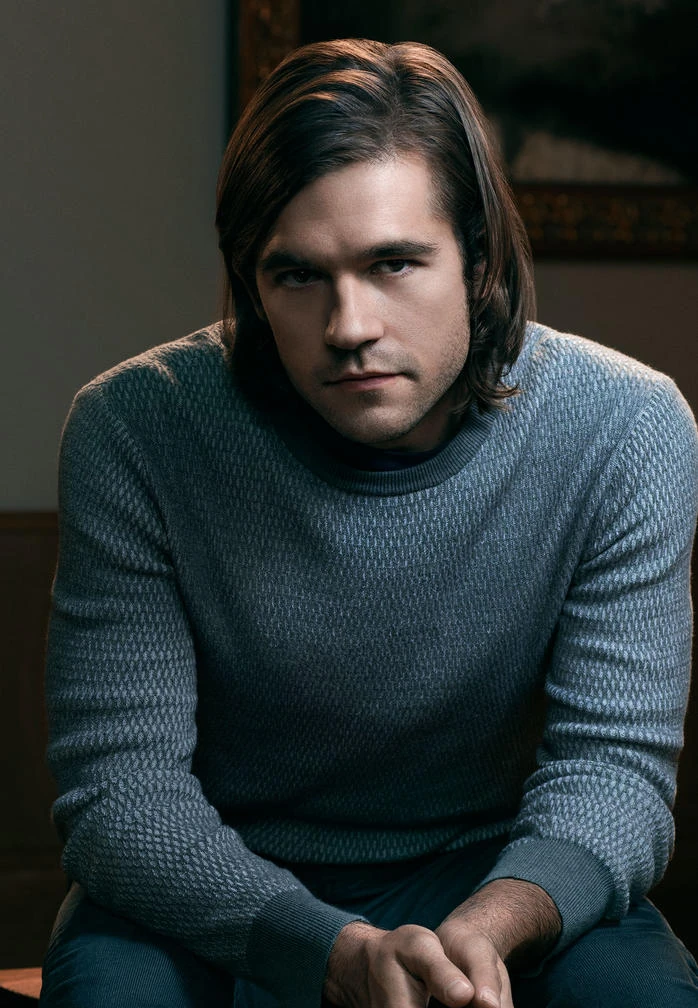
The one and only Quentin Coldwater

Wednesday, January 11, 2017

Battlestar Galactica 2017!

WARNING
BAD PUN DISCLAIMER
How can you tell if your buddy is a Cylon? see if they make really good toast... da dum tss...


By Wesley, John, Jonah and Katie
For anyone who has not seen Battlestar Galactica, it is honestly a must see in my mind. I was not at all surprised when i found out that this show was the most well received throughout the previous binges. There has never been so much science and religion in one sitting, let me tell you.. it's one hell of a show! there was a moment where I  regretted buying all of season 2 on amazon to watch our last two or so episodes, but now its fine because I know ill be coming back to finish it, but maybe a month or two from now. sitting down and watching a few episodes on your own time is one thing, but having to watch it and write about it every day for six hours is another. I think I can speak for my whole group when there have been times we really didn't want to have to sit down and click that play button for the sixth time that day. With the first phase of this binge out of the way, the next two are going to be much smoother I think. If it were to snow again, and I had another cup of hot coco in my hands, them i'm sure this is going to be more bearable than I was expecting.

Binging Mad Men

Rewinding more than 50 years into the past, Mad Men reminds the viewer how different the times were in the 1960s. In 2017, we picture our ideal world diverse and fruitful with all different types of lives, jobs, and families of various shades. In 1963, Mad Men presents a much alternate society where (white) men would work in an office day in and day out with (women) secretaries by their side, then go back home to their housewife, children, and picketed fence. Binge watching Mad Men certainly revealed the truth of an era that is often not discussed on television.
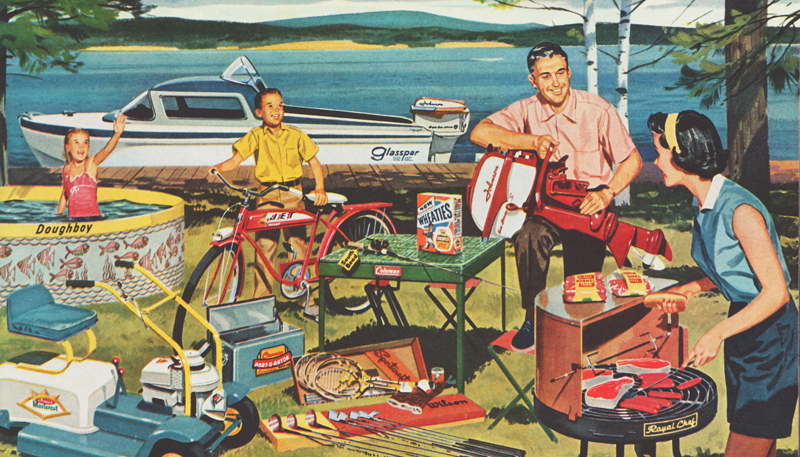
Image result for the american dream 1960s


The 1960s presented unspoken yet suggested set of norms and expectations held by each household at the time, as a family and as an individual. The first clear custom shown throughout Mad Men is the constant use of drugs. At the time, there was little to no information on how bad drugs like alcohol and tobacco was for the body and the environment. Many everyday working class adults would smoke in their office, meetings, and conferences with ease and even some of the higher ranking heads drinking casually throughout their shifts.
Even drinking and driving was perceived much more differently, with simply getting a fine for drinking over the legal limit. It was even common and almost expected for businessmen to smoke while in flight. In comparison to today, one would presume that drug usage would apply differently to pregnant women as well but that was not the case. Women expecting did not change their diet of drinking and smoking as there were no evidence on those drugs affecting their baby.
In terms of marriage, Mad Men makes the idea clear throughout the show with multiple homes and families. A part of ‘the American Dream’, it is expected from your parents, friends, and, family that one marries young, has children young, and stay together old. There was a serious stigma against divorcing your spouse and adopting a child that is not yours. Divorced women were often thought of as whores and families who adopt were often looked down upon socially. The entire concept of ‘the American dream’ clearly affects and reflects on the time; showing a cookie cutter approach to life here in the United States. In today’s era where everyone often looks to be diverse and unique, Mad Men offers a period where the expectation was otherwise.
Another cool thing Mad Men does is reveal a character’s inner thoughts and feelings through seemingly unrelated imagery. For instance, on the second episode of the pilot season, we get a scene featuring our anti hero protagonist, Don Draper, in his home late at night, calling his wife’s psychiatrist for an update on how her therapy session that day went. As Don and the psychiatrist begin their conversation, Don closes the door to the room he is in; the camera pulls back in the direction that the door is being pushed, distancing us the audience a few feet from Don and the phone, but not outside the ability to hear their conversation. Then, as the camera is pulling back, it swerves slowly to the right, pointing the audience’s view through another doorway which frames a set of stoves sitting one atop the other, indicating to us the Draper house kitchen. The camera lingers on the stoves in the kitchen while Don’s phone call continues just to our view-point’s left. Pair the conversation about Don’s wife with the psychologist and the image of the Draper family stoves, and the message becomes clear: Don Draper is inclined to believe his wife should “stay in the kitchen,” out of a belief that she is mentally ill.
    The shot shows us Don’s inner feelings toward his wife, and the attitude toward women in general during 1960s America. In Mad Men, The feminine sex is less stable than the masculine sex, without directly telling us what the shot represents. To understand the shot at all, one would have to have knowledge of the attitudes of men towards women in those days. It takes a certain amount of trust in the sharp-mindedness of the audience for a filmmaker to place such a scene in their film, a trust not so very often afforded the audience at all. The way Mad Men crafts it’s scenes to show us a character’s inner beliefs, or to comment on the general attitudes of that particular place in time, or both at once, is subtle and graceful. It is indeed a pleasure to watch unfold.


The early 1960’s were a tumultuous time in our country; a bright, popular, charismatic president was just elected to office, the civil rights movement was gaining real traction and war with the Soviets loomed over the heads of every citizen. The brief moment of hope and opportunity is showcased brilliantly by the world created by the writers and set designers of the show.  The audience is able to picture a day in the life of a 1960’s American citizen from the wallpaper, costuming, and dialogue between characters.
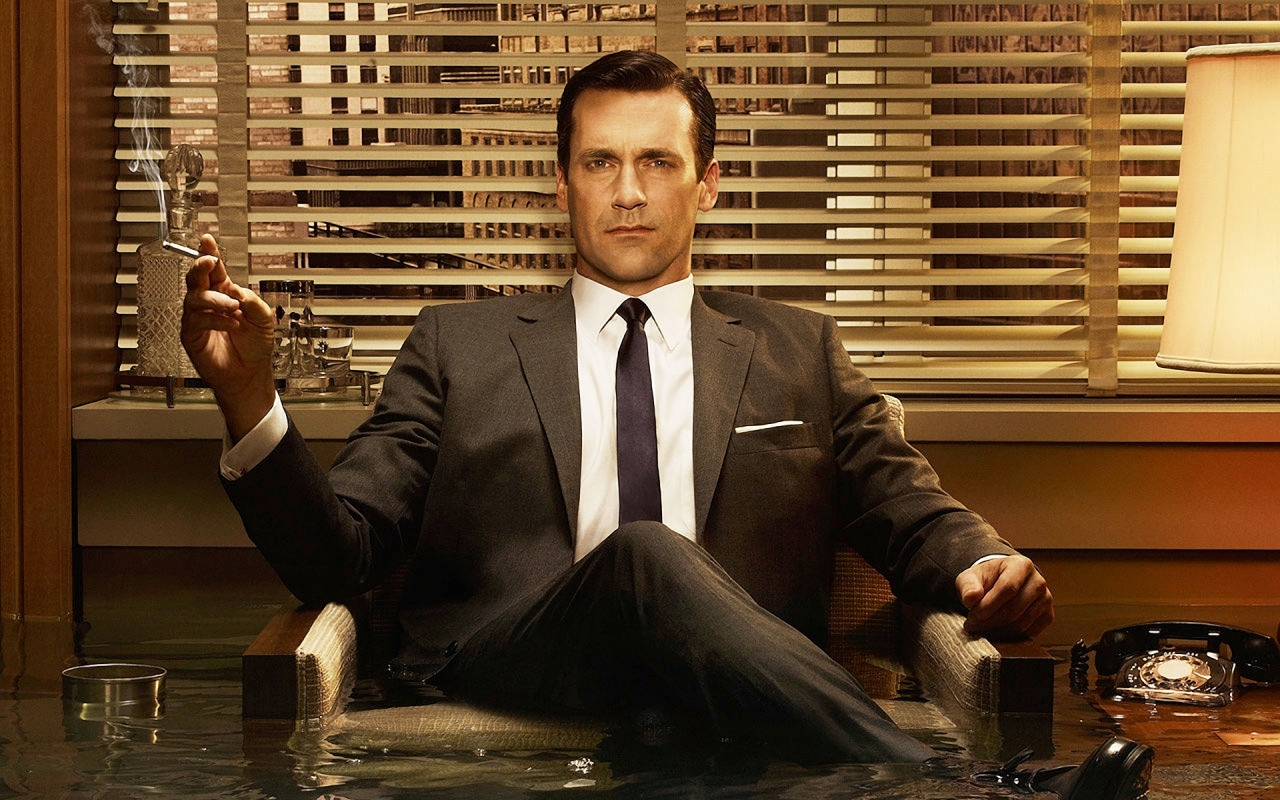
Image result for don draper mad men

   The show’s writers were quite clear in depicting that Americans had a different mindset regarding health, daily life and the role gender and sexuality plays in these hemispheres.  It is made clear in the opening scenes where the main character, Don Draper, is shown smoking cigarettes and pouring himself and his co-workers some whiskey. Even his boss slyly remarks to Draper after a very important business meeting. “I’m not sure whether you were drunk or not…. But that was brilliant.”  This would not be acceptable behavior in a modern-day workplace but just over half a century ago it was.  
Many of the working men at the time had served in World War II, thus the inflated egos and sense of “manhood” that was commonly shown in the workplace.  The way men and women are told should and shouldn’t act are constantly forced onto both sexes.  Discouraging any deviant behavior from these societal norm. With manipulation of the media through advertising, Sterling-Cooper were able to bend and twist the truth for their products; reflecting onto the entire working class.

Mad Men provides the binge viewer with insight to a time in America that is long gone; yet many themes represented throughout the show are still relevant in 2017. Mad Men gave the viewer all it could ask for with the its skillful use of fluid storytelling and shocking plot twists; which is quite intriguing during the binge process.

Clone Club: Binge Watching Orphan Black Together


Imagine living your everyday life and on your way to bank one day you run into … yourself?


In just three days, we (Emma, Jenny, Kinye, Kristina, and Mallary) plowed our way through over two seasons of Orphan Black. We laughed and gasped our way through this series, and we fell in love with the show’s host of quirky characters. Why?

For our tv binge, our group watched Orphan Black. This show follows the adventures of Sarah Manning as she discovers her place in a world of corporate conspiracy and long-buried secrets. Sarah discovers she is a clone, made for a top secret experiment. She becomes part of a group (nicknamed "Clone Club") allies among her fellow clones and friends as they unite to unravel the mystery of why their creators made them.

Over the course of the weekend, we found that binge watching as a group was a different experience than binge watching it in private. To begin with, the group found watching the show together to be a more enjoyable experience. By watching it in a group, it became a social experience. It was fun to enjoy others’ experiences in addition to our own. We would all laugh, gasp, or curse at different things. Watching it together allowed us to feed off of each other's enthusiasm.

Part of the appeal of binge watching television is the instant gratification of getting to the next part of the story. But we also discovered that binge watching in a group allowed us another kind of instant gratification. Because we were all on the same page within the show, we could freely share our reactions with one another as events in the show unfolded. We only needed to turn to one of our peers to begin a conversation about what we have just witnessed together.

Our experiences of binge watching alone, on the other hand, varied wildly. One of us thought that it was easier to become immersed in the story when watching alone, because there were fewer distractions demanding our attention. However, other members of our group thought that it was harder to binge alone. Without a group keeping us involved in the show and each other, focusing on a screen for three hours was more difficult.

You later find out that you, along with your ‘identical’ population are clones apart of a science experiment. You have recently learned that you yourself has become ‘self aware’. Along with other secrets kept from you, you discover that you have a monitor who watches you daily and reports back intel. Who do you think would be your monitor?

A Dreadful Binge: Penny Dreadful Binge 2017

             For the 2017 January term Binge class, we (Ronald, Collin, and Hadis) the students have to choose a TV show, a book, and a video game to binge on for 18 hours, for each binge type. For this first binge, my group chose to binge on the TV series, Penny Dreadful. My group found that the beginning of this series was very slow and didn’t initially grab our attention due to the show focusing on establishing setting and all the different characters. After the initial bump we started to understand the purpose of the different characters allowing the show to have room for character development. The characters started to matter.

Aside from having this new experience with the show, having to binge for six hours a day for three days is strenuous. Our daily lives have already consisted the consumption of media, either playing video games or even binging for our own personal enjoyment. With this binging, playing video games or watching more TV felt too much, and it sort of interfered internally. It was as if our personal media consumption and overload on top of the class binging. It’ll be interesting to see how we feel on our first day from binging.

Binge watching with the group felt more enjoyable than it did when we binged alone. The feeling of comradery along with the ability to interact with what we are watching with other people makes it more enjoyable. Each of us as individuals notice slightly different things and when pointed out, we all get a sense of a full understanding of what is going on before our eyes. Everyone has his or her own point of view and see’s different things as the plot unfolds. Spoiler Alert Like one of our group members calling out that one the characters was a werewolf early on in the show and when it was revealed, proceeded to rub it in our faces. We wonder how more binges will affect us, whether that be positive or negative. We will see.